
Offense is Cheap
The Offense-Entitlement Feedback Loop: Part I of V

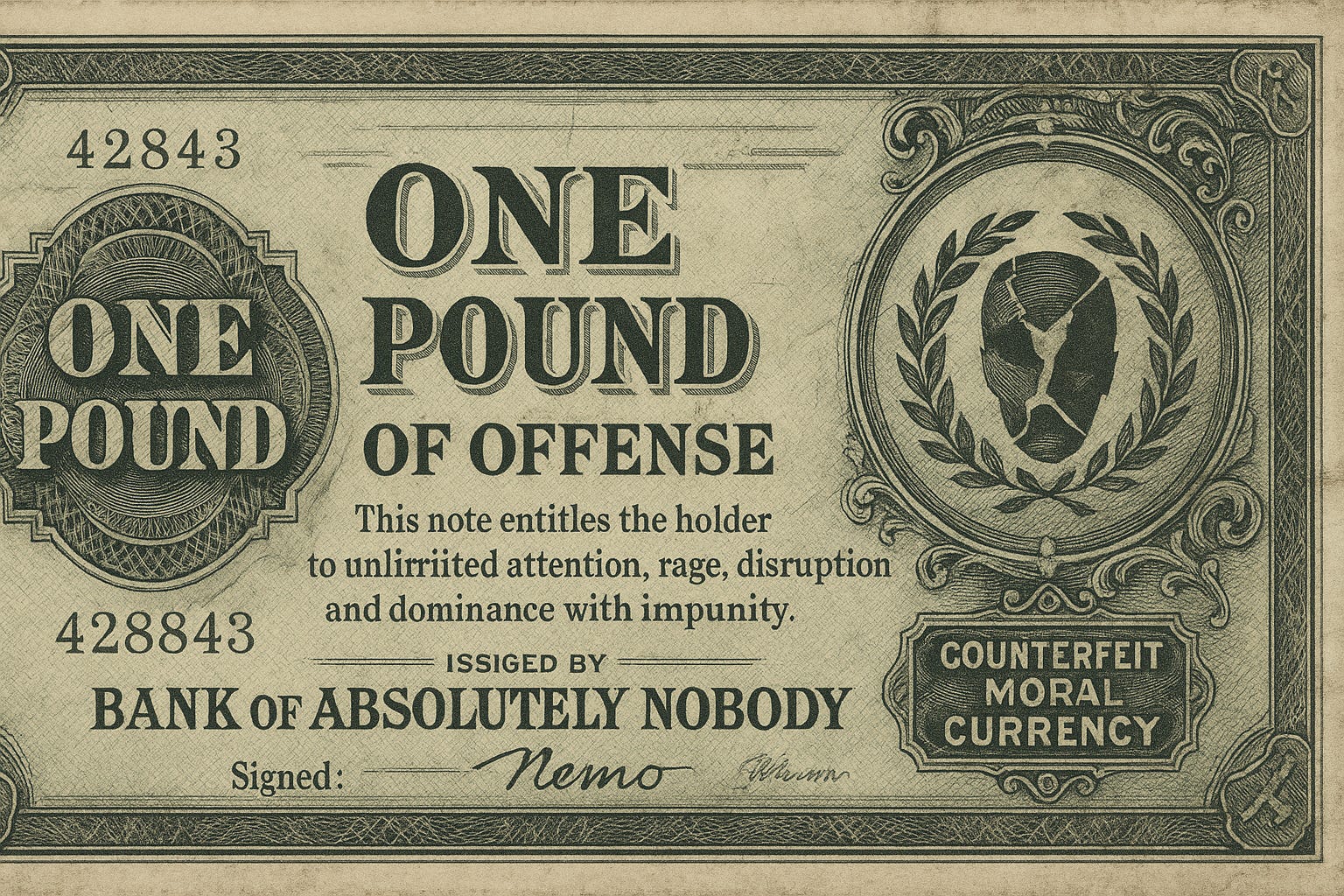
I have been wrestling with how to approach an obstacle that has been of great concern to me for some time. I invest tremendous time and energy in articulating the woes of our age, their import and their remedies. It is exceedingly frustrating to achieve such articulation with clarity and accuracy, yet to have my words fall on deaf ears. Some find my style too high register to digest; that’s perfectly all right. I am most concerned, however, by those that have both the cognitive faculties and frame of reference to understand my words, yet something in the operating system causes them to reject entertaining them. There are a few culprits that generate this obstacle, but there is one in particular that I have spent some time exploring, researching, analyzing and parsing: the offense-entitlement feedback loop. The topic quickly made itself known to be too large to cover in just one essay, therefore this is the first part of a series. I have produced several, very different drafts and have been fretting over how to produce something that satisfies my high standards. Thankfully (all puns intended), Thanksgiving has given me the inspiration I needed to settle on the order of things.
I write polemics and critiques of our society because I believe that we are not doing the best we can to live in a better world, the particulars of which are to be found in the details (like God and the Devil). One of the fundamental components of my memetic model is what I call the “Good Wolf/Bad Wolf Paradigm”. Dawkins and his successors have all treated memetics as an amoral field, treating culture as a kind of parasite that piggybacks on our biology. I strongly disagree with this view; I believe that culture is now the primary substrate of natural selection and evolutionary adaptation in our species, and that morality forms the basis of that substrate. Do the memes that we grok lead us to happiness or despair? To care or neglect? To discipline and compromise or base instincts and violence?
The Good Wolf/Bad Wolf Paradigm finds its origins in a Native American myth. I have heard various versions, but it goes something like this: a grandfather explains to his granddaughter that inside each of us live two wolves—the Bad Wolf gives us fear, anger, hatred, cruelty, anguish, malice, violence and despair, while the Good Wolf gives us faith, courage, love, care, appreciation, satisfaction, beneficence, peace and hope. The two wolves are constantly in conflict with one another for dominance inside us. The dominant one ends up defining our personality and the impression we make on others. The granddaughter asks, “Grandpa, which wolf wins?”
“The one that you feed,” he replies.
In simplest terms, this allegory illustrates how positive, healthy memes reinforce each other and lead to greater satisfaction and wellbeing, while negative, destructive memes do the inverse.
The offense-entitlement feedback loop very much belongs to the domain of the Bad Wolf. In focusing on iterating its essence and function, I felt that something was missing. Eventually, I realized that what was missing was the Good Wolf’s alternative to the same: the humility-gratitude feedback loop. I have created certain new terms but the argument I shall present shortly is rooted in solid research and academic consensus across decades.
Before we dive in, allow me to practice what I preach.
Thank you, from the bottom of my heart. It has been a somewhat lonely experience to hold all of these thoughts in my head, to myself. I am deeply grateful to you for allowing me to share them, and taking the time to read them.
The Price of Offense
Offense is cheap.
It always has been, but never more so than now. People invoke “being offended” with the gravity of a moral wound, yet most of the things that animate their indignation would not register as a papercut in a sane civilization. A mispronounced name. An imperfect holiday greeting. A stranger’s clumsy joke. A pronoun. A micro-delay in the instant gratification of their preferences.
I do not live in that register. A slur does not offend me. A caricature does not offend me. Random undergraduates chanting “Zionism is racism” in sweatshirts and borrowed slogans do not offend me. Someone calling me “kike” is not an injury; it is a weather report about their mind. The kinds of things that generally offend people tend not to bother me, because offense requires investment, and I do not grant strangers—especially stupid or derivative ones—the privilege of wounding me.
The threshold is different when it comes to covenant. Israel’s “allies” choosing to recognize “Palestine” on Rosh HaShana is deeply offensive. A professor mispronouncing my name is not offensive. Scheduling a mandatory exam on Shabbat is. A stranger’s insult bounces off; betrayal from those who know better cuts. Real offense is not about feelings, it is about violated expectations of honor, loyalty, or decency. It costs something.
Cheap offense does not. It is counterfeit currency—and counterfeit always floods the market.
Ironically enough, it is offense that ultimately led me to this writing. Allow me to illustrate costly offense with an example from my own life.
The most wounding thing that was ever said to me, was said by a close friend (at the time) who is a biomedical engineer. A smart, nerdy guy, somewhat on the spectrum. He had been working out intensely for some years but wore atrocious clothing which stood an inch off his body as he was in the 99.9999999% percentile of human body hair. I gently nudged him in the direction of and eventually gave him a total makeover. Okay… some Russian ladies did the actual laser removal of his hair; but I took him shopping and picked all the clothes. He credited me with “upping his game”, including matching with his eventual wife.
He told me that I was an evolutionary aberration because I was a homosexual. He had reduced my entire being to aberrant because I was poorly positioned to sire offspring. Never mind that I had materially contributed to his chances of doing so. This touched on my self worth in a way that I instinctively rejected wholeheartedly. I want children, but that is beside the point.
We do not select mates based on their ability to hunt or gather; we want them to make money and have a good sense of style. Our evolutionary substrate is memetic. My genetic contribution may not have been guaranteed, but I have an outsized memetic one. Nevertheless, the offense did not lead to a sense of entitlement. It led to a need for vindication.
Across media, corporate governance and activism, cheap offense is promoted and rewarded. It is profitable, scalable, addictive. Offense generates entitlement, and entitlement functions as a kind of social credit. This is how a civilization loses its ability to distinguish between what wounds the soul and what merely bruises the ego. The trivial becomes existential; the existential becomes cliché.
Offense is how one proves existence.
Societies that cannot tell the difference between insult and injustice cannot calibrate their response. They either underreact to real atrocities or overreact to trivial slights. Often they do both at the same time. A brittle society always confuses fragility for justice.
This is not an accident.
It is a consequence of how we talk.
Offense as Moral Currency
There is a reason offense feels powerful.
It is the quickest way to mint moral authority. When someone declares “that is offensive,” they are not merely reporting a feeling; they are proposing a contract. They seek acknowledgment of harm, validation of grievance, and concessions from those around them. Offense is a demand for recognition. Entitlement is the payout.
In a healthy moral economy, costly offense generates legitimate entitlement—rights to justice, reform, protection. The problem arises when offense becomes cheap. Every trivial slight becomes a claim to moral reparations. Every feeling becomes a credential. Every discomfort becomes an entitlement to obedience from others.
Every claim of offense comes bundled with a claim of entitlement.
If I am hurt, I am owed.
If I am offended, you must respond.
This is the moral economy of victimhood. Offense is how you generate credit. Entitlement is how you spend it. The more you can demonstrate that you are wounded—personally, ancestrally, structurally—the more moral capital you possess. That capital can be spent on attention, on special rules, on exemptions from criticism, on the power to punish.
A civilization cannot sustain this without collapsing its own standards of meaning.
Entitlement: Fact or Feeling?
It is critical to make the distinction between entitlement and a sense of entitlement. “Entitlement” gives away its true meaning etymologically: the thing to which one is entitled must be named officially—i.e. given a title. In this sense, entitlement is a very real memetic construct that has been codified time and again by both religion and state. Who is entitled to what is not something amorphous, to be negotiated in the moment, but rather something clearly iterated in referential text or custom.
By contrast, a sense of entitlement is a defining feature of one’s psychology that may or may not be rooted in the former. The sense of entitlement shared by medieval and early modern aristocrats was a product of codified deference which they experienced in their quotidian lives. In this case, the two align. Likewise, the patient that demands an explanation from her doctor rather than dismissal, is (in our society) entitled to do so according to our laws.
The woke-scold who polices speech and silences anyone “problematic”, however, is misaligned. This person has a sense of entitlement, despite no law or regulation that actually grants them such. Those possessed by a sense of entitlement tend to be unconcerned with external conditions that guarantee them something; their thoughts, beliefs and demands all stem from internal references. They believe they are entitled, and thus act accordingly.
In today’s world, emotional resonance is more immediately persuasive than reason and civil exchange. Epistemic certainty (confidence) is rewarded as tautological proof that conviction renders a thing true. The fact that it is untrue is irrelevant in the way conversations unfold because the belief is reinforced through confirmation. Every time someone validates the person’s sense of entitlement by giving in to their bullying, the bully becomes more confident in his own sense of entitlement.
The imposition of one’s sense of entitlement onto others is defended by impersonal speech.
The Grammar of Offense
The age of cheap offense is built on a very particular kind of sentence.
It is not “I am offended.” It is “That is offensive.”
The distinction looks trivial on the page. It is not. The first is an honest report of a subjective state. The second is an act of legislation.
In a previous essay about impersonals and obedience,1 I traced how power learns to speak without showing its face. “It is required.” “It is not allowed.” “That’s just not done.” These constructions erase the speaker and present the command as if it comes from the structure of reality itself. No one is telling you what to do; the universe is. The sentence arrives pre-sanctified and self-reinforcing.
Offense has adopted the same grammar.
“That’s offensive.”
“That’s harmful.”
“That’s not okay.”
“It’s problematic.”
These are not conveyed as personal expression but an ethereal verdict. The sentence arrives as a meteorite from some abstract realm called Justice, Diversity, Safety, Progress. The individual making the judgment disappears. The judgment remains.
This is the grammar of obedience repurposed as the grammar of grievance.
We are trained in it from childhood. “It’s for your own good.” “That’s not appropriate.” “You can’t say that.” By adulthood, the pattern feels like weather. Every language offers its own devotional phrases:
French: il ne faut pas
Spanish: hay que
Russian: нельзя
Arabic: haram
Hebrew: אין לעשות את זה
Each presents prohibition as a property of the cosmos, not of the speaker.
When this structure migrates into the realm of offense, it does something quiet and devastating. It removes the requirement that people own their reactions. A sentence like “I feel insulted because…” invites conversation. A sentence like “That is offensive” closes it. One points back to the subject, the other toward an invisible tribunal.
Moral conversation becomes impossible when every reaction is phrased as a law.
Authority Without a Face
Impersonals are not inherently evil. Civilization cannot function if every rule must be prefaced with a personal essay. “It is necessary to evacuate the building” is not tyranny; it is survival. “It is required to file taxes by April 15” may be annoying, but it is at least clear. Impersonals at their best are tools: they coordinate action, ease friction, and distribute responsibility in complex systems.
“That’s offensive” is a different creature from “It is necessary to fasten your seatbelt.” One is a description of physics and regulation. The other is a claim about the moral order of the universe disguised as etiquette. Both are impersonal, yet only one presents subjective experience as objective law.
This is where cheap offense finds its power.
If my feeling is an event in my nervous system, you are free to engage, to question, even to ignore. If my feeling is presented as the voice of Safety or Justice, you are guilty by definition if you do not submit.
Offense framed impersonally creates authority without authorship.
No one has to say, “I, this particular human with my particular history and fragilities, judge you.”
The sentence does the judging by itself.
One Crazy in the Room
Many years ago, I was guiding an interfaith university group around Israel. This was the only tour I gave that had a sizable pro-Palestine contingent (though not as virulent as today). I make no pretense of being a neutral entity—I am an Israeli Jew—but I am a stickler for the facts, dispassionate, diplomatic and knowledgeable. These people kept interrupting me with idiotic declarations. At one point, they even signed a petition. Never mind that they had accepted the money of Jewish philanthropists to go on a two-week, all-expenses-paid trip abroad. I took the group to Yad VaShem, whose museum is extraordinarily well designed and curated. The end of the museum is the Hall of Names, containing the database of all those Jews who perished in the Shoah (Holocaust). Of the twenty two students, twenty were crying; but two were bored and annoyed. While most were still drying their eyes, having just internalized some part of the enormity of the evil that was the Shoah, one of the two decided to subject us to a diatribe on how the museum made her uncomfortable because it failed to mention Palestinians.
I was disgusted. We had lunch and continued onto Mt. Herzl Military Cemetery (adjacent to Yad VaShem), and I bit my tongue often enough to bleed. At the end of the day, I spoke with the rabbi, who was leading the trip, and his wife about how to deal with the disrespectful clique (ranging from two to five at its height).
The rebbetzin told me something that has stayed with me ever since: there is only room for one crazy in the room, and you must choose whether to be that crazy or not. It is an elegant description of a brutal truth about attention. Emotional escalation monopolizes the field. Enraged people, hysterical people, perpetually offended people—they seize the entire bandwidth of the group simply by refusing to regulate themselves.
We strategized, and decided that the rebbetzin was the best candidate to have a counter meltdown at dinner. As those offended on behalf of Palestine began to present their petition—feeling entitled not only to a free lunch (and room and flight), but also to monopolize the group’s attention—the rebbetzin had a controlled meltdown, and let out all of the anger and frustration that most of us had been suppressing for the sake of group cohesion.
Healthy people self-regulate. Fragile people do not. This asymmetry confers power. The person willing to scream, cry, accuse, or have a meltdown gains control of the room because no one else is willing to debase themselves that far. Their volatility becomes a gravitational center that others must orbit. This dynamic is the interpersonal expression of the offense-entitlement loop: the loudest grievance wins, not the truest one.
Civilized people do not want to be the crazy in the room. They may employ the tactic strategically on occasion, normally as a last resort. There is a room full of bickering and one chooses to lose it: “enough!”
Entitled people play the role as a matter of course. Entitlement is an egotistical quality—they’re not being strategic to create order, they are chaotic and destructive in order to dominate.
Fragility, Cheap Offense & How It Travels
Cheap offense spreads quickly because it is frictionless. It costs nothing and demands everything. It requires no courage, no dignity, no intellectual effort. It is the tantrum dressed as moral insight. Fragility is its engine. Fragile individuals are hypersensitive to disruption and respond to discomfort as if it were danger. The slightest misalignment becomes a violation; the smallest inconvenience becomes oppression.
In such a moral landscape, offense becomes a performance of vulnerability rather than an expression of harm. It is how fragile people project strength: by weaponizing their weakness. Cheap offense travels because it shortcuts the entire process of moral reasoning. You do not need to explain, persuade, or justify. You merely need to declare, loudly enough, “that is offensive,” and others are expected to collapse into compliance.
Societies saturated with cheap offense become unlivable. They are held hostage by the emotionally unwell. Cheap offense is not sensitivity. It is fragility—the more fragile the psyche, the more intolerable the slightest disruption feels. Fragile people gravitate toward offense because offense offers the illusion of power. It disguises weakness as righteousness.
Wounded animals in a cage are the most vicious.
Their reactions are not strategic; they are reflexive. They lash out not because the threat is real but because they feel cornered.
The offense-entitlement pairing traps entire societies in that posture.
A culture that believes feelings confer authority becomes governed by its most brittle members. Emotional dysregulation becomes civic participation. Neutrality becomes complicity. Resilience becomes oppression.
The Narrowing of Speech
Once offense guarantees entitlement, speech narrows.
It becomes safer to avoid entire categories of expression than to navigate nuance. People censor themselves not out of concern for another’s dignity but out of fear of what they may suddenly owe them. There is a common expression that epitomizes this.
“Stay in your lane.”
An offense-entitlement society cannot sustain subtlety.
It cannot sustain humor.
It cannot sustain disagreement.
The boundaries of permissible speech shrink until only platitudes remain. Everything interesting becomes dangerous; everything dangerous becomes forbidden.
“Stay in your lane,” is a perfect distillation of the mentality that the offense-entitlement feedback loop creates. At once, you let your interlocutor know that they have offended, you invalidate their right to free expression, while claiming authority over the topic at hand.
Those who have been silenced unintentionally reinforce the legitimacy of the silencer; the entitled person not only expects deferential treatment, but insists on defining the parameters of exchange for everyone. As the feedback loop pervades the discourse, those disinclined to conflict will self-edit ad absurdum.
How Cheap Offense Learns to Travel
Offense, expressed impersonally, becomes highly portable. It can be shared, reposted, reenacted. You do not need to have personally suffered anything to feel entitled to outrage. You simply align yourself with the impersonal declaration.
“That statement was harmful to Black people.”
“That image is triggering for survivors.”
“That policy is violence.”
In each case, speakers step into the robes of universal spokesperson. They borrow the pain of others without asking for permission. They score the benefits of victimhood without paying its costs.
Once upon a time, offense marked events: the desecration of a grave, the violation of sanctuary, the humiliation of an ally. Today offense is minted continuously at industrial scale. Everyone carries a personal press.
This is where Malicious Memetic Mimicry begins its work at the linguistic level, long before bricks fly. Malicious memes do not need to invent new syntax; they simply graft their payload onto existing structures of authority. A phrase like “It’s settled science” functions identically to “God wills it” in earlier eras. A phrase like “That’s offensive to marginalized communities” functions identically to older blasphemy laws. The grammar is the same: It is so, therefore you must.
The ease with which these sentences spread is not evidence that they are true. It is evidence that they are grammatically optimized for replication. They demand obedience and solidarity in the same breath. They offer the speaker safety and status at once: you cannot be criticized for siding with “it is.”
Offense becomes cheap because its expression no longer costs anything. You do not risk relationship, reputation, or skin by hiding behind impersonals. You are rewarded. The more things you can declare offensive on behalf of others, the more virtuous you appear.
Entitlement and the Collapse of Well-Being
The psychological research is stunningly clear on this point: entitlement predicts misery.2 Across dozens of studies, entitled individuals score higher on distress, instability, conflict, anger, relational breakdown, and chronic dissatisfaction. Their self-esteem is brittle, their expectations inflated, their ability to cope with disappointment impaired. Entitlement corrodes well-being because it generates a permanent mismatch between what one demands and what the world will ever willingly provide.
We’ve all encountered such a person. I remember a very pretty girl at summer camp. It was 2004 and we were 17 or 18. The camp I attended in interior British Columbia, was neither fancy nor pampering. The dwellings were crude, the showers communal, the food awful, and it was the best fun. It’s not that appearances were irrelevant—teenage hormones and a whole summer in a bathing suit does make one somewhat body conscious. Fashion, however, was nowhere to be found. Nor was it the point. This girl spent the entire summer talking about how much better Toronto was than Vancouver, how rich she was—or at least her father was—the car her father bought her and how we shouldn’t judge her for her camp outfits (no one was). The last few days of camp, she started going on about how she “better have a Tiffany’s necklace waiting for me on my pillow when I get home.”
I was very confused. I could never have imagined being indignant and bratty towards my parents and hope to receive luxury gifts. But this Torontonian had spent the entire summer letting everyone know that she was used to and deserved better than camp, B.C. and us.
The internal logic of entitlement guarantees unhappiness:
the more you believe you deserve, the less you will ever feel you receive.
A person who expects gratitude feels grateful.
A person who expects deference feels perpetually slighted.
A person who expects the world to mirror their emotions finds the world intolerable.
The offense-entitlement loop does not merely damage society. It destroys the individual who adopts it.
Humility: The Memetic Membrane
I never gave that much thought to quantifying my happiness until I learned about the World Happiness Report in high school. One of the things I found most striking about it was that happiness did not necessarily correlate with wealth. Many wealthy countries at peace had quite unhappy populations, while many of those with poverty and in conflict had quite happy populations.
The determining factor between the two worlds—entitlement and gratitude—is humility. Humility is the refusal to place oneself at the center of the moral universe. It is the ability to recognize that one’s feelings are not laws, one’s preferences are not rights, and one’s discomfort is not a claim on others. Humility decentralizes the self. It makes space for perspective, resilience, and proportion. It is the cultural immune system that prevents cheap offense from metastasizing.
Entitlement is impossible without egoic inflation. Gratitude is impossible without egoic de-escalation. Humility is the membrane between the two feedback loops—the Bad Wolf and the Good Wolf. It is no accident that every civilization with staying power ritualized humility in its moral codes. Humility is not decorative. It is the only thing that protects a society from the madness of grievance.
Its opposite, of course, is hubris. The self-referential authority presumed by those suffering from the offense-entitlement feedback loop, is inevitably arrogant, and obviously so to the dispassionate observer.
I remember, some time in university, reading a paper on MRI scans of happy people, and that the happiest person to have been studied was a French man who had become a Buddhist monk. He was interviewed about the catalyst to having such a happy brain. Buddhist monks practice radical non-attachment to an illusory existence defined by suffering. The monk named his one catalyst for a happy brain: gratitude.
Gratitude: The Counter-Economy
Gratitude is what fills the space that offense once occupied. Gratitude is the emotional expression of humility—the recognition that good things come from outside oneself, that the world is not organized around one’s desires, that daily life is mostly composed of gifts one did not earn. Gratitude expands the world. Entitlement shrinks it. Gratitude produces stability; entitlement produces volatility. Gratitude invites reciprocity; entitlement demands submission.
Every study on human flourishing says the same thing: gratitude increases happiness, resilience, meaning, intimacy, and physical health. It is the most reliable generator of well-being ever discovered in psychology. It is the opposite of the offense-entitlement loop in every way imaginable.
The Good Wolf and the Bad Wolf feed on different diets. What they eat are memes.
My life has not always been good, nor has it always been obvious that it would get better. At some point I found myself at the bottom of a pit so deep, it felt like an abyss. At that low place, the Bad Wolf was all powerful, life seemed like it would never improve. I knew that I had to change something in order to climb out of that abyss. I write these words to you today, having completed a pretty harrowing ascent to—somewhere in the middle. It’s a work in progress, but one that I am committed to sustaining for the rest of my life. I remembered the French Buddhist monk and began to seriously ponder gratitude.
It was in the most dire of settings that despite my misery and despair, I looked around and saw people who had actually managed to sink lower than I had. They had no grasp on reality, no way up. I knew that I had within me the capacity for awe and wonder, with vague memories of the me that also experienced them. Awe and wonder aside, I still had my languages, my intellect, my family, my people and (somehow) my looks. I abandoned the Bad Wolf for the Good Wolf when I stopped lamenting all I had lost and suffered and felt genuinely grateful to be me. I remain grateful.
Everything I’ve described at the personal level scales outward. Memetics are fractal—they organize in the same patterns in the individual as in society at large. The difference between civilizations that endure and civilizations that implode is which wolf they choose to feed.
A culture that feeds the Bad Wolf eventually becomes him.
Part I has described the mechanism. The rest of the series will trace the damage it has already done.
From Honor to Victimhood, Part II, looks backward, to the moral economies mankind once used to restrain offense and calibrate response.
The Riot and the Meme, Part III, studies the present, where offense mutates in public, where crowds become amplifiers and movements lose their shape.
The Half-Life of the Credibility Cloak, Part IV, examines what happens when grievance solidifies into identity—when the credibility cloak refuses to decay and becomes a permanent garment.
The Freeze, Part V, looks at those who never leave the moment of injury, who remain suspended in time, preserved in the amber of their own outrage.
Bibliographical Note on Entitlement, Humility, and Gratitude
The claims made here about the correlation between entitlement and psychological distress, as well as the inverse relationship between humility/gratitude and well-being, rest on a substantial and long-standing consensus in the psychological sciences. Over the past two decades, researchers have repeatedly demonstrated that entitlement predicts higher rates of interpersonal conflict, chronic dissatisfaction, anger, and emotional instability; while humility and gratitude consistently predict greater happiness, resilience, pro-social behavior, relationship quality, and even improved physical health outcomes. The works below represent a sample of this literature.
Selected Sources
Campbell, W. Keith, Angelica M. Bonacci, Jeremy Shelton, Julie J. Exline, and Brad J. Bushman.
“Psychological Entitlement: Interpersonal Consequences and Validation of a Self-Report Measure.” Journal of Personality Assessment 83, no. 1 (2004): 29–45.
Exline, Julie J., Joshua Hook, Daryl Van Tongeren, and Everett Worthington, Jr.
“Humility as a Source of Psychological Strength: The Role of Accurate Self-Assessment, Other-Orientedness, and Perspective-Taking.” Personality and Social Psychology Bulletin 38, no. 6 (2012): 708–25.
Grubbs, Joshua B., Julie J. Exline, Daryl R. Van Tongeren, and Everett L. Worthington, Jr.
“The Psychology of Entitlement: A Review and Synthesis.” Psychological Bulletin 140, no. 6 (2014): 233–62.
Lambert, Nathaniel M., Frank D. Fincham, Steven R. Stillman, and Tyler F. Exline.
“Gratitude and Psychological Need Satisfaction: A Two-Wave Longitudinal Study.” Journal of Positive Psychology 5, no. 1 (2010): 39–52.
McCullough, Michael E., Robert A. Emmons, and Jo-Ann Tsang.
“The Grateful Disposition: A Conceptual and Empirical Topography.” Journal of Personality and Social Psychology 82, no. 1 (2002): 112–27.
Emmons, Robert A., and Michael E. McCullough, eds.
The Psychology of Gratitude. New York: Oxford University Press, 2004.
Van Tongeren, Daryl R., Joshua B. Grubbs, Everett L. Worthington, Jr., and Julie J. Exline.
“Why Do People Feel Entitled? A Group-Level Analysis of Entitlement and Conflict.” Group Processes & Intergroup Relations 19, no. 4 (2016): 527–40.
Davis, Don E., Joshua Hook, Daryl Van Tongeren, et al.
“Humility and the Development of Virtue.” Journal of Moral Education 44, no. 1 (2015): 1–17.
Froh, Jeffrey J., Giacomo Boniwell, and Adam M. Bernstein.
“Gratitude and Well-Being in Adolescence: A Longitudinal Investigation.” Journal of Positive Psychology 6, no. 4 (2011): 295–305.
I loved your previous exam of how impersonals impact us on a daily basis. I loved this post as well. I am trying to classify what it is that you do. Is this philosophy? Linguistics? Social science? I have no idea. What, (aside from « Grokking reality ») would you call these posts?
This article is long, so I’m skimming and then reading more closely. You handle this topic so skillfully and gave me new ways to think about
“offense”and the ways in which it has impacted our society. Thank you.