
What Does “Happy Holidays” Even Mean?
Not a Rhetorical Question


Happy holidays.
Which ones, exactly?
The phrase is offered generously and received politely, yet it points to nothing in particular. It floats, unanchored—too vague to be wrong, too familiar to be questioned. Are we celebrating multiple holidays at once, or simply hedging our bets? Is this an act of inclusion, or a way of avoiding specificity altogether? At some point it becomes worth asking whether any of this still means what it claims to mean, or whether we are all participating—willingly or not—in a carefully staged seasonal performance whose original purposes have been flattened into mood.
What’s striking is not that the phrase exists, but that it has become necessary. “Happy holidays” emerges precisely when people are no longer confident about what they are acknowledging, yet still feel obligated to acknowledge something. It functions less as a greeting than as a social disclaimer: I recognize that this time of year matters to people, and I don’t want to get it wrong. Goodwill without reference. Politeness without content.
That vagueness would be less interesting if it weren’t paired with excess. There are, suddenly, so many holidays—stacked tightly together, competing for attention, light, sentiment, and spending. Christmas, Hanukkah, Kwanzaa, New Year’s, Lunar New Year, seasonal “festivals,” winter “celebrations,” year-end rituals of every description. Even those who don’t meaningfully observe any of them feel the gravitational pull. The calendar swells, but meaning does not necessarily deepen with it.
Why Are There So Many Holidays Right Now?
Winter is long, restrictive, dark, metabolically and socially unpleasant. This inevitability has been assuaged by ritual compensation since time immemorial. Societies marked this period with controlled indulgence, with light against darkness, with feasting against scarcity. What’s changed is not the need, but the justification. Where earlier cultures chose a metaphysical story to sanctify winter interruption—God incarnated, the sun reborn, the year reset—modern societies are no longer willing to choose. So they layer. Instead of committing to a reason, they accumulate gestures.
The result is not pluralism so much as overdetermination. Light everywhere. Cheer everywhere. Music everywhere. The point is no longer why one celebrates, but that one participates. Celebration becomes ambient. Relief, not reverence, is the common denominator.
The vagueness of “Happy Holidays!” is remarkably populated with concrete, fixed iconography. Red and green. Bobbles and trees. Gift wrapping. Candy canes. Nine or seven pronged candelabras. Illumination. Somewhere in the distance is a snowman with a carrot for a nose in a fur hat, adorned with a wool scarf.
Do People Know What They’re Celebrating?
This helps explain why people increasingly struggle to articulate what they’re actually celebrating, and why they don’t seem particularly troubled by that confusion. There was once an expectation that holidays were intelligible because they were inherited. You learned them before you understood them. Meaning arrived through repetition, family, mild coercion, and only later through explanation—if at all.
That order has reversed.
Now explanation precedes participation. Placards explain. Advertisements explain. Wikipedia explains. Even the rituals explain themselves, often explicitly. Enumeration replaces inheritance. Principles are listed. Symbols are glossed. The holiday arrives with footnotes.
It turns out that there can be value in repeating the rote motions, even in the absence of their understanding or iteration. Some holidays survive meaning-loss remarkably well. Thanksgiving is the clearest example: historically shaky, morally muddled, yet stubbornly effective. It works because it commits families to at least one event a year, the point of which is to strengthen bonds: being together. One eats with family on a fixed day. The ritual does not require belief; it requires presence. Its myth is thin, but its cadence is thick.
Others fare less well. When a holiday must constantly explain itself in order to justify its existence, when it demands recognition rather than assuming it, something fragile is exposed. The need to be understood replaces the authority to obligate. Participation becomes optional, symbolic, and ultimately performative.
Gift-giving illustrates this inversion perfectly. In theory, a gift is chosen because it will bring the recipient joy or utility—because it reflects attention, knowledge, or affection. In practice, contemporary gift culture has become a minefield of budget compliance and price signaling. The anxiety is no longer did they like it? but did it meet expectations?
A recent J.C. Penny ad for this “holiday season” makes this explicit. One cousin gifts another a faux-fur coat purchased for $75. The recipient assumes it cost far more. “You shouldn’t have!” Embarrassment ensues—not because the gift failed, but because it violated an unspoken budgetary script. The recipient is apparently most touched by the perceived $200 cost of the gift. She shoots her boyfriend a dirty look (why didn’t you spend this much on me?!) The boyfriend’s concern is not the coat, nor the joy it brings, but the breach of an agreed-upon price tier. “I thought we agreed on a budget,” he laments.
This is not generosity hollowed out by accident. It is generosity automated. The giant retailers—Amazon, Walmart, Home Depot et al.—now offer “amazing gifts under $25, $50, $100, $200,” relieving buyers of the burden of thought while preserving the appearance of ritual participation. The gift giver genuinely and dutifully purchases, and the recipient has a specific new gift. But both the thinking and the procedure behind the exchange have been adapted for the convenience and to the advantage of the seller. Selection replaces attention. Compliance replaces care. The gift satisfies the ritual obligation without risking asymmetry, surprise, or vulnerability. Often this depersonalization creeps into the small talk at holiday parties. Everyone is playing their part in an implicit corporate script.
None of this requires cynicism to sustain. It requires only that holidays function as performances—visible, legible, and socially validated—rather than as sanctified acts whose meaning emerges internally through obligation and repetition. When that shift occurs, it becomes possible to celebrate without knowing why, to give without thinking, and to wish others well without referring to anything at all.
“Happy holidays,” then, is not an empty phrase because people are careless. It is empty because it is doing exactly the work now required of it.
At the heart of this confusion is a distinction that modern holiday culture has largely lost the ability to make: the difference between performance and sanctification. Performance is outward-facing. It wants to be seen, recognized, validated. It is legible from the outside and therefore explainable, replicable, and scalable. Sanctification works in the opposite direction. It is inward-facing. It does not care whether it is understood, approved of, or even noticed. It binds those who submit to it through obligation, repetition, and cost, and it often becomes opaque precisely because it is lived rather than displayed.
Sanctification does not require force. It requires cost. The difference matters. A ritual binds not because it coerces participation, but because opting out carries consequence—social, temporal, or symbolic—that cannot be negotiated away in advance.
When a ritual is sanctified, its meaning does not need to be advertised. It proceeds whether or not it is aesthetically pleasing, convenient, or inclusive. It can be resented, resisted, or misunderstood and still endure. Performance, by contrast, depends on recognition. It must be intelligible to observers, affirming to participants, and compatible with surrounding norms. It cannot tolerate indifference, and it collapses under friction.
This difference explains why some holidays feel heavy even after their stories fade, while others feel brittle despite their moral clarity. A sanctified ritual obligates before it explains; a performative one explains because it cannot obligate. In a culture increasingly uncomfortable with exclusion, cost, and compulsion—even mild, familial compulsion—performance becomes the safer substitute. What is lost in that substitution is not warmth or goodwill, but authority. And without authority, rituals may persist as gestures, but they no longer bind.
Assembly vs. Inheritance: Kwanzaa and the Nouveaux Riches Problem
The “Holiday Season” in the United States is dominated by three holidays: Christmas, Hanukkah and Kwanzaa. The first two long predate late-stage Capitalism and the Union itself. Kwanzaa is very much the youngest tradition among the three. It was invented in 1966 by Maulana Karenga, in the thick of Black Power, Afrocentrism, and post–Civil Rights identity reconstruction. Karenga did not invent Kwanzaa ex nihilo. He assembled it—consciously—out of Pan-African nationalism, the Swahili language, Christian ritual cadence, Marxist and communitarian ethics, and Afro-Semitic mythologies already circulating in Black American culture.
Kwanzaa presents itself as a corrective: a reclamation of dignity, ancestry, and meaning in a season otherwise dominated by commercialized Christianity. It is earnest, intentional, and explicitly moral. Yet—to many observers, including some broadly sympathetic to its aims—it registers as oddly hollow. Not offensive. Not malicious. Just unmistakably assembled.
This reaction is often dismissed as prejudice or unfamiliarity, but that explanation doesn’t hold. Plenty of people encounter unfamiliar rituals without finding them contrived. What marks Kwanzaa as different is not its newness, but its relationship to visibility. Kwanzaa wants to be recognized as meaningful. It does not assume authority; it asks for acknowledgment.
The comparison to the nouveaux riches is not metaphorical flourish; it is structural. When wealth is inherited, its codes are absorbed long before they are articulated. One learns, often unconsciously, what is excessive, what is vulgar, what need not be displayed. Status is communicated through restraint, omission, and ease. The point is not to be seen having wealth, but to move through the world as though it requires no explanation.
Those who acquire wealth without having been raised inside those codes face a different problem. They possess the material access but not the memetic fluency. In response, they over-signal. Logos grow larger. Explanations proliferate. Taste is mimicked rather than cultivated, expressed through visible abundance. One does not simply own something; one must demonstrate why it is valuable, how much it cost, and what it signifies. To insiders, the performance reads immediately—not as immorality, but as late arrival.
Kwanzaa exhibits the same pattern, transposed from class to culture. It does not assume inherited fluency. It compensates with visibility, symmetry, and explicit moral narration. Its symbols are carefully curated and prominently displayed; its values are enumerated, named, and recited aloud. Nothing is left tacit. Nothing is allowed to sediment quietly over time. The holiday does not trust repetition to generate meaning; it demands comprehension in advance.
This is not accidental. It is the predictable result of attempting to generate sanctity without lineage. Where inherited traditions rely on constraint, silence, and unchosen obligation, Kwanzaa relies on clarity, articulation, and voluntary assent. The result is a ritual that behaves like conspicuous consumption: earnest, carefully assembled, and unmistakably performative to anyone fluent in older ritual grammars.
This insistence is the tell.
Sanctified rituals do not enumerate their virtues. They burden participants with them. They do not advertise coherence; they survive incoherence through repetition. They allow meaning to sediment over generations, accruing friction, argument, and resentment along the way. Kwanzaa, by contrast, is frictionless by design. Participation is optional. Exit is costless. Nothing bad happens if it is skipped, forgotten, or reinterpreted.
From the inside, this does not feel artificial. It feels necessary. Kwanzaa answers a genuine wound: the rupture of ancestral continuity, the theft of history, the desire for grounding in a culture that has systematically denied it. The sincerity is real. But sincerity cannot substitute for sanctification. Intention does not generate authority. And without authority, rituals must rely on performance to sustain themselves.
This is why Kwanzaa explains itself so relentlessly—and why it cannot afford to acknowledge the provenance of its iconography. To name its debts would be to reintroduce hierarchy, comparison, and asymmetry. It would expose the holiday not as recovered inheritance, but as curated synthesis. Silence, here, is not oversight. It is structural.
The tragedy is that Kwanzaa is judged by a standard it never chose. It is asked to compete with traditions that accumulated meaning through centuries of constraint, exclusion, and obligation. It cannot win that contest, because it has refused those tools. What remains is performance—earnest, visible, morally articulate performance—but performance nonetheless.
Seen through this lens, Kwanzaa’s failure to sanctify is not a moral failure. It is a memetic one. The holiday does exactly what modern culture permits: it performs values without binding those who enact them. And in doing so, it reveals the limits of performance itself.
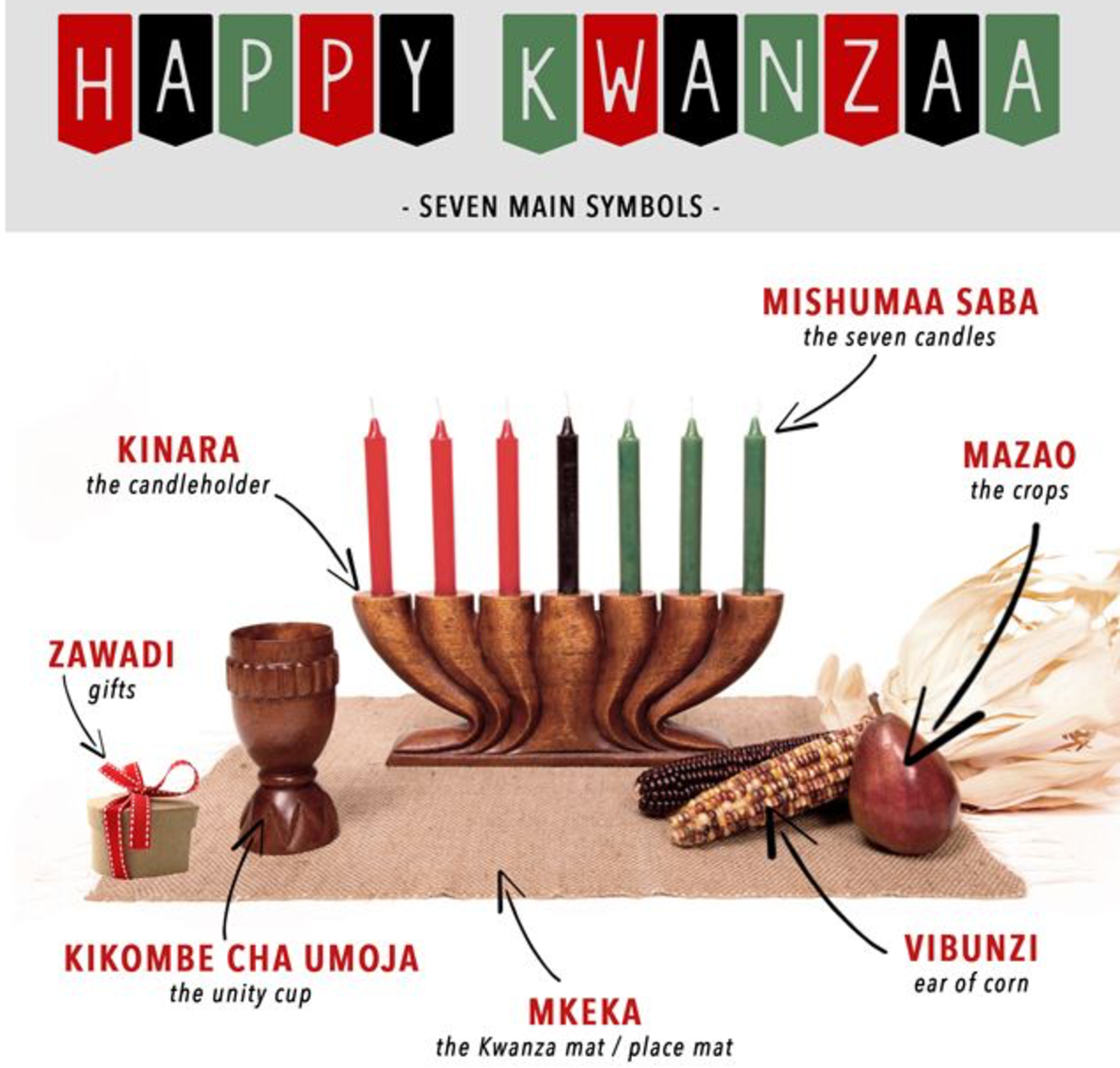
Borrowed Icons and Curated Absence
Rituals announce their lineage whether they mean to or not. Objects remember what people try to forget. Later on, we’ll encounter “New Years Trees” and a blue Santa. Ugly Hanukkah sweaters.
Kwanzaa’s central icon—the kinara—reveals this tension immediately. A candleholder placed at the center of a table. Candles lit sequentially across nights. One light used to kindle the others. Abstract values mapped onto visible flame. This is not an arbitrary configuration. It is a very specific ritual grammar, one already well established in the American cultural landscape long before 1966.
What is striking is not that Kwanzaa’s iconography resembles Jewish ritual objects, but that this resemblance goes entirely unacknowledged. One will search in vain, including in ostensibly neutral reference sources, for any mention of the Chanukkiah, the menorah, or Hanukkah as relevant precedents. The silence is total. This is not an oversight. It is a decision.
The resemblance cannot be waved away as generic candle use. The Temple menorah was an oil lamp, tended by priests, embedded in cultic space. It was not a domestic teaching device. The Chanukkiah, by contrast, is explicitly post-Temple, household-based, pedagogical, and temporal. It translates historical memory into nightly practice. It is designed to make abstraction visible through light, and to do so incrementally, in public or semi-public domestic space. These are the affordances Kwanzaa adopts.
Kwanzaa modifies the form—seven candles rather than eight plus a shamash—but retains the logic. The modification gestures backward to cosmic completeness and to the seven principles that must be accommodated. What it does not do is acknowledge the intervening inheritance. The ritual grammar is borrowed, simplified, and recontextualized, but its origin is left unnamed.
This absence matters because sanctified traditions are not embarrassed by their borrowings. Judaism is explicit about adaptation: oil becomes candles; priestly ritual becomes domestic law; catastrophe becomes pedagogy. These transformations are argued over, recorded, and preserved precisely because authority is not threatened by memory. A tradition that knows where it comes from does not need to hide its scaffolding.
Kwanzaa cannot afford that transparency. To acknowledge the Chanukkiah as precedent would immediately introduce hierarchy and comparison. It would reframe Kwanzaa not as recovered Africanness, but as diasporic synthesis—accurate, perhaps, but destabilizing to the holiday’s claim of ancestral continuity. Silence becomes a defensive measure. The icon is retained; the lineage is erased.
Whether this absence is strategic, inherited, or simply unexamined ultimately matters less than its effect. A lineage that cannot be named cannot be metabolized. Rituals deepen through argument, memory, and reinterpretation; silence forecloses all three.
This is the broader pattern: modern constructed rituals tend to treat icons as modular rather than genealogical. Symbols are selected for legibility and affect, not for the obligations they once carried. Once detached from their originating constraints—law, taboo, argument, exclusion—the icons remain visually potent but memetically light. They glow, but they do not bind. Nothing could be more convenient for Madison Avenue.
The result is a holiday that looks like ritual without behaving like one. The objects perform meaning, but they do not enforce it. Because the lineage is unspoken, the ritual cannot deepen through argument or reinterpretation. It can only repeat itself, unchanged, or fade.
Icons can survive transplantation. Many have. But they do so only when their histories are allowed to travel with them. When those histories are suppressed, what remains is not synthesis but decor—earnest, intentional decor, yet decor nonetheless.
Hanukkah Isn’t Jewish Christmas—So Why Is It Treated Like One?
I recall the first time I was told not “to mention the Hanukkah bush.”
What is a Hanukkah bush?! my seven-year-old brain demanded to know.
I had grown up with Hanukkah candles, songs, and fried foods. I knew about the Maccabees, about rededication, about light without abundance (and latkes, and dreidels and gelt). I did not know about bushes, trees, stockings, or evergreen anything. The very phrase sounded like a category error—a botanical confusion born of anxiety. Someone, somewhere, had felt the need to supply Judaism with a Christmas-shaped accessory.
That moment was my first encounter with the American insistence that every visible minority tradition occupying December must play the same role. Winter has a slot. The slot expects cheer, lights, gifts, family warmth, and visual abundance. Anything that appears nearby in the calendar is quietly drafted into service, whether it belongs there or not.
Hanukkah is particularly vulnerable to this conscription because it is minor, late, and visually adaptable. It involves candles. It involves light. It can be made decorative. And crucially, it does not demand fasting, absence from work, or legal obligation. Its real gravity—minority resistance, rededication after desecration, survival without triumph—does not translate easily into retail grammar. So it is overridden.
In American culture, Hanukkah is not allowed to be what it is. It must become what Christmas already is: a winter-friendly celebration of togetherness. Blue replaces red. Stars replace angels. The grammar remains the same. The result is not inclusion, but substitution.
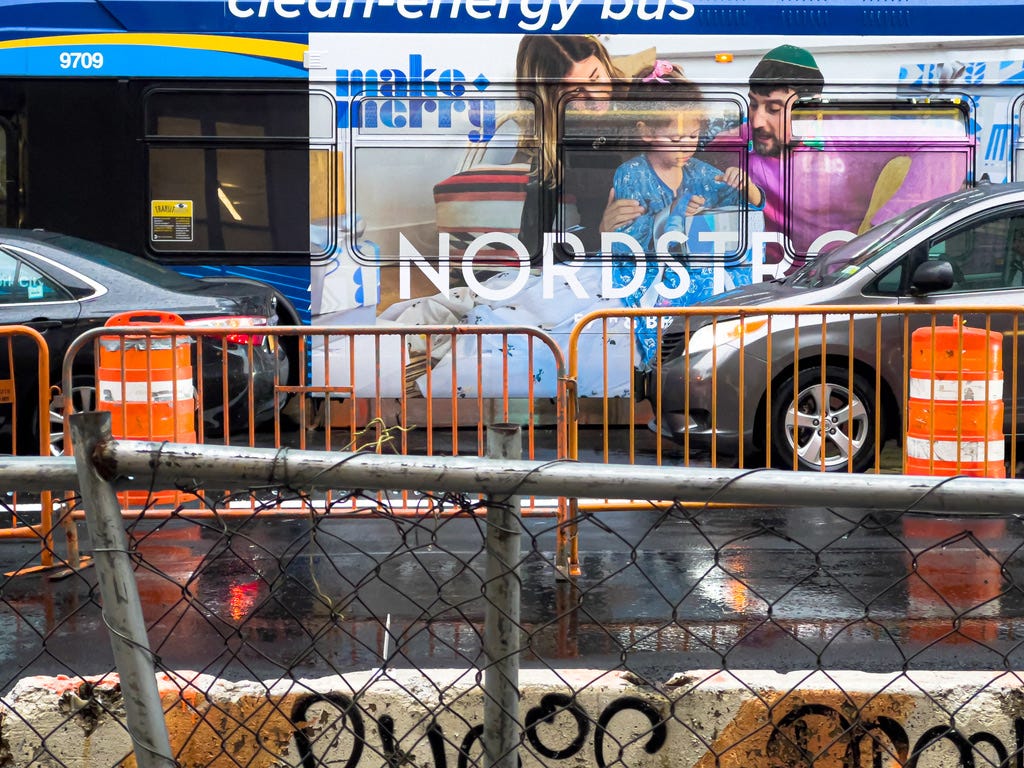
A few years ago, Nordstrom ran a holiday campaign featuring a “Jewish family” posed in a living room that would be immediately legible to any American viewer: a fireplace, stockings, wrapped gifts, and a prominently placed evergreen just out of frame. The palette was unmistakable—blue and silver in place of red and green—but the grammar was identical. The caption read: Make Merry.
The bus pictured above contained a portion of this ubiquitous ad. What made the image unsettling was not its intention, which was clearly inclusion (and sales), but its assumption. Jewishness was not presented as its own calendrical logic or ritual system. It was presented as a themed variation on Christmas. Blue stockings replaced red ones; a kippah replaced a Santa hat. The structure remained untouched.
This is how American pluralism often operates in practice. Difference is permitted only at the level of surface aesthetics, never at the level of temporal authority. The Jewish calendar is not allowed to interrupt December; it is allowed to decorate it. The result is not recognition but ventriloquism—Judaism made to speak Christmas with an accent.
This is why Jews so often find themselves explaining—again and again—that Hanukkah is not the Jewish Christmas. The explanation rarely lands, because the misunderstanding is not intellectual. It is structural. American culture does not organize time around calendars; it organizes it around seasonal affect. December is for warmth and generosity. Any tradition present during that period is pressed into the same emotional labor.
Retail culture accelerates this flattening. Ugly Hanukkah sweaters, blue-and-white wrapping paper, menorahs designed to sit comfortably next to pine garlands—all of it reassures the surrounding culture that nothing disruptive is happening. Judaism has been rendered legible, festive, and non-obligating. No one needs to learn anything. No one needs to change their schedule. The calendar remains intact.
What is lost is not merely accuracy, but authority. Hanukkah’s refusal to become a feast, its insistence on modest repetition rather than abundance, its resistance to spectacle—these are not bugs. They are the point. The holiday commemorates a moment when Jewish practice survived not by expansion, but by narrowing. Light was preserved without empire. Memory without triumph.
That meaning cannot survive translation into Christmas terms. Once Hanukkah is asked to perform seasonal cheer, it ceases to sanctify anything at all. It becomes decorative Judaism: visible enough to signal inclusion, shallow enough not to interfere.
The “Hanukkah bush” was never about helping Jews celebrate. It was about helping Christmas remain universal. And that is the recurring pattern. Universal systems struggle to tolerate opt-outs. When they encounter difference, they do not attack it. They absorb it, recolor it, and return it as a variation on themselves.
In that sense, Hanukkah’s transformation is not an accident or a misunderstanding. It is a successful assimilation into a dominant seasonal script—one that prefers performance to sanctification, and comfort to authority.
Precisely why it feels so wrong.
Red Cups and Empty Symbols: The Starbucks Controversy
Starbucks is no amateur when it comes to Commercial Memetic Commodification. It is thanks to the Seattle-based coffee chain that autumn was transformed from a set of climatic conditions into “pumpkin spice”—a flavor profile in which no pumpkins were harmed, consulted, or required. This maneuver was not merely successful; it was paradigmatic. A season was condensed into an aesthetic, an aroma, and a purchasable ritual. Every other multinational corporation followed suit, dutifully releasing its own pumpkin-spiced derivatives on schedule.
But Starbucks wandered into blasphemous territory when it attempted something more ambitious: modifying Coca-Cola’s greatest act of CMC a century earlier—the commercialization of Christmas.
Coca-Cola did not invent Christmas, but it perfected its modern performance. The red-and-white Santa, the promise of warmth amid cold, the suggestion that consumption itself could mediate seasonal joy—this was not accidental branding. It was ritual engineering. Christmas, once sanctified by theology and later hollowed by industry, had been stabilized as a dependable emotional environment. Red meant December. Red meant cheer. Red meant permission.
Conveniently, red also mean Coca-Cola.
When Starbucks introduced its minimalist red holiday cup—deliberately stripped of snowflakes, ornaments, nativity-adjacent imagery, or even the word “Christmas”—it did not remove meaning so much as reveal how little remained. The outrage that followed was swift and revealing. Accusations of a “war on Christmas” poured in, despite the absence of any actual ritual interference. No dates were changed. No celebrations were prohibited. No practices were curtailed.
What had been violated was not sanctity, but ambient validation.
The red cup had been doing quiet ritual work for years. It signaled seasonal arrival. It told customers they were participating correctly in the time of year. When the symbolism was reduced to pure color, the emptiness became visible—and intolerable. People were not defending Christ, nor tradition, nor even nostalgia. They were defending the expectation that the season would feel the way it always had, without asking why.
The irony, of course, is that Starbucks was accused of secularizing something it had never sanctified to begin with. The cup controversy revealed a truth more uncomfortable than sacrilege: that Christmas, in its dominant public form, had already been reduced to a managed mood. All Starbucks did was momentarily drop the mask.
This is why the controversy could never be resolved by explanation. No amount of clarification about inclusivity or neutrality could satisfy critics, because the complaint was not propositional. It was affective. The ritual had failed to perform its role. The season had been made strange.
In that moment of panic, the difference between sanctification and performance was exposed with unusual clarity. Sanctified rituals survive misunderstanding, dissent, and even neglect. Performed rituals collapse the moment their cues are disrupted. The Starbucks cup mattered because, for many people, it had quietly become the ritual itself.
Which is to say: when a paper cup can trigger a cultural crisis, the sacred has already been replaced by branding.
Christmas Music and the Occupation of Sound
If Coca-Cola gave America the visual grammar of Christmas, then a small cohort of twentieth-century composers supplied its sound. Together, they completed the transformation. Christmas no longer needed theology, doctrine, or even narrative coherence. It had images, and now it had music.
This was not a continuation of earlier Christian tradition. It was a replacement. Out went the carols—dense with incarnation, angels, kings, and judgment. In came something lighter, faster, and infinitely repeatable. “Jingle Bells.” “White Christmas.” Songs about snow, longing, sleighs, romance, home. Songs that required no belief and asked nothing of the listener beyond recognition.
It is not incidental that many of the composers who shaped this new Christmas liturgy were Jewish. Irving Berlin’s “White Christmas” did more to define the emotional landscape of the holiday than any hymn written in the previous three centuries. This was not an act of subversion, nor irony. It was an act of translation—taking a Christian holiday already in the process of secularization and furnishing it with a soundtrack that could survive that transition.
What emerged was something unprecedented: a holiday whose meaning was no longer carried by story or ritual, but by repetition. Christmas music does not teach. It does not commemorate. It occupies. It fills public space—stores, streets, offices, elevators—with a compulsory emotional register. Cheer is no longer invited; it is enforced.
Unlike visual symbols, which can be ignored or avoided, sound penetrates. One does not consent to Christmas music. One is subjected to it. The same handful of songs recur endlessly, their familiarity substituting for meaning. Nostalgia replaces sanctity. Recognition replaces belief.
Over time, this repertoire hardened into canon. Very few songs have managed to penetrate it. Mariah Carey’s “All I Want for Christmas Is You” succeeded not because it added meaning, but because it perfected the formula: romantic longing, seasonal cues, relentless repetition. José Feliciano’s “Feliz Navidad” works for the same reason—it adds a linguistic flourish without disrupting the emotional script. The holiday absorbs difference so long as the affect remains unchanged.
This is liturgy by saturation.
In earlier religious contexts, music structured time. It marked specific moments. It taught doctrine through melody. Here, music does the opposite. It erases distinction. The same songs play for weeks on end, dissolving Advent, Christmas, and New Year into a single undifferentiated mood. Time is no longer sanctified; it is anesthetized.
This helps explain why Christmas music inspires reactions disproportionate to its content. The irritation many feel is not about taste. It is about coercion. The listener is denied the option of silence, reflection, or neutrality. The season insists on being felt in a particular way, and it insists loudly.
Once again, the difference between performance and sanctification asserts itself. A sanctified ritual tolerates dissent, boredom, even resentment. It does not need constant reinforcement. A performative ritual, by contrast, must be reiterated endlessly lest it dissolve. The volume compensates for the hollowness.
Coca-Cola’s Santa made Christmas visible everywhere. Christmas music makes it unavoidable. Together, they ensure that participation is no longer a matter of belief or practice, but of exposure. One does not celebrate Christmas so much as endure it.
When endurance is mistaken for meaning, the holiday has completed its final transformation: from sacred time, to seasonal performance, to background noise.
False Universals and the Violence of Polite Ignorance
The American obligation to never offend almost invariably leads to deeply offensive expressions, reflective not of malice but of ignorance. This ignorance is often well intentioned, even anxious. It wants to include everyone. It wants to smooth edges. It wants to universalize courtesy. It wants and intends; but what it does is reliably erase difference.
“Lunar New Year” is a perfect example.
Once upon a time, Americans wished one another a Happy Chinese New Year. This was imprecise, but not incoherent. The holiday was understood—correctly—as culturally Chinese, even if it was also celebrated elsewhere in East and Southeast Asia. Over time, in an effort to avoid excluding Vietnamese, Korean, or other non-Chinese celebrants, the phrase was re-encoded as “Lunar New Year.”
The result is a term that sounds inclusive while being conceptually nonsensical.
There is no such thing as the Lunar New Year. Judaism has one. It falls in the autumn. Islam has an entirely lunar calendar, with no intercalation at all. The Jewish year and the Muslim year drift differently through the seasons. Neither has dragons. Neither uses red envelopes. Neither marks the same date. The moon alone does not unify these systems. It fragments them.
What “Lunar New Year” actually means is “the East Asian New Year we are trying very hard not to call Chinese.” The specificity is removed, but not replaced with understanding. Difference is not honored; it is blurred.
This pattern repeats everywhere in the American ritual landscape. Precision is treated as exclusion. Particularity as aggression. To name something accurately is increasingly felt as a failure of manners. So language is softened, broadened, and emptied until it can offend no one—except those who actually belong to the traditions being flattened.
“Happy Holidays” operates the same way. It pretends to gesture toward multiplicity while quietly enforcing sameness. The holidays it gestures toward are not equal participants. One dominates the season’s affect, visuals, soundscape, and commercial infrastructure. The others are permitted so long as they do not disrupt the prevailing mood.
This is why Jews are told, earnestly, that Hanukkah is “basically your Christmas.” Why Muslims are asked about Ramadan in December. Why East Asian traditions are collapsed into a single lunar abstraction. The offense lies not in hostility, but in the assumption that all rituals must be interoperable—convertible into the same emotional currency.
Universalist systems struggle with opt-outs. Christianity, especially in its Americanized form, was built to universalize. Capitalism was built to scale. When these two systems converge, they produce a culture that cannot tolerate calendar dissent. It must either absorb difference or rename it until it fits.
What results is a polite monoculture. Everything is celebrated. Nothing is understood. Symbols circulate freely, stripped of constraint, obligation, and history. They are pleasant. They are legible. They are safe.
And they are hollow.
At the end of this process, no one is truly included. Traditions lose their edges. Calendars lose their authority. Rituals lose their power to bind, to interrupt, to demand. What remains is performance—seasonal, well lit, carefully curated performance—mistaken for meaning.
Novy God: When the State Salvages Winter Ritual
Soviet State Atheism could not tolerate perennial markers being derived from tradition because tradition had hitherto been religious. If American capitalism hollowed out Christmas by overfeeding it, the Soviet Union tried something even more audacious: it attempted to delete Christmas altogether. This did not work. Winter does not tolerate vacuum. The calendar will be filled, one way or another, because human beings need something to break the darkness—something to mark survival as more than endurance.
So the Soviet state did what modern states do when they discover they cannot abolish a ritual: it repurposed it.
The tree remained, because the tree is older than Christianity and deeper than theology. An evergreen in winter is not an argument. It is a visual fact. It is life asserting itself against the season. The problem was not the tree. The problem was what the tree meant—and who owned that meaning.
So meaning was reassigned. Christmas became New Year. The feast moved from December 25 to January 1. The family gathering remained, the children remained, the sweets and the ornaments remained. The time off remained. What was removed was sanctification: the claim that any of this pointed beyond the household, beyond the state, beyond material life.
Even Santa could be kept, so long as he was metabolized into something else. Ded Moroz—Father Frost—arrives not as Saint Nicholas, and not as a Christian moral pedagogue, but as a winter figure, a folkloric emissary of the season itself. If Coca-Cola’s Santa is red and warm and indulgent, the Soviet winter figure is colder, more distant, and often blue. Blue is not merely aesthetic. It signals removal from Christian inheritance, and it signals removal from blood-and-velvet sentimentality. It is winter, made bureaucratic.
This is why Novy God works, in the narrow sense that it persists. It does not pretend to be ancient. It does not pretend to be sacred. It offers no metaphysical story. It offers sanctioned indulgence and a clean temporal reset. Low ambition. High survivability.
Which raises a useful comparison for the American case. The Soviet state overwrote sanctification with ideology. American capitalism overwrote sanctification with consumption. Both produced functional winter rituals. Both replaced transcendence with management. The difference is that Novy God is honest about what it is, while American Christmas continues to cosplay as something it no longer consistently believes.
Can One Build Ritual from Shells?
The temptation, at this point, is to say that manufactured holidays fail because they are manufactured, and inherited holidays succeed because they are old. That is too simple. Age helps, but it is not the mechanism. The mechanism is weight.
Rituals become real when they impose costs that cannot be bypassed without consequence—social, emotional, logistical, spiritual. They become real when they generate obligations that are not negotiable in the moment. They become real when people argue about them, resent them, interpret them, distort them, and keep doing them anyway. Sanctification, in other words, is not the presence of beauty or meaning. It is the presence of constraint.
Shells can be assembled into something that looks like ritual. Candles can be lit. Words can be recited. Symbols can be curated. Food can be designated. Calendars can be printed. But shells are lightweight. They do not bind. They do not interrupt. They do not create consequences for abstention. They do not become dangerous.
This is why corporate holidays are so efficient. They remove every form of friction that would make ritual real. They retain the aesthetics and delete the costs. They preserve the glow and remove the demand. Nothing could be more convenient for Madison Avenue: a holiday that repeats reliably, scales universally, and requires nothing beyond purchase and performance.
Shells are not useless. They can carry memory for a time. They can scaffold belonging. They can provide a template for those who have lost inheritance. They can even harden into sanctity over generations—if, and only if, they become embedded in constraint. If participation stops being voluntary. If repetition accumulates conflict. If exit becomes costly. If the ritual becomes capable of embarrassing you, inconveniencing you, obligating you. If it acquires the power to say: not everything is for everyone.
Herein lies the paradox. The modern desire for maximum inclusion produces rituals too weightless to include anyone deeply.
Conclusion: The Season as a Machine for Flattening
None of this is an argument against goodwill. The problem is not kindness. The problem is the substitution of kindness for comprehension, and performance for sanctification.
In the United States, the holiday season increasingly functions as a machine: it takes incompatible calendars, incompatible theologies, incompatible ritual grammars, and processes them into a single seasonal affect. Everything becomes lights. Everything becomes cheer. Everything becomes shopping. The forms remain recognizable enough to signal “diversity,” but the differences that would make that diversity meaningful are quietly shaved down.
A society that cannot tolerate ritual constraint cannot tolerate ritual truth. It cannot tolerate the possibility that some communities have calendars that do not map onto its own, and that those calendars are not decorative. It cannot tolerate the possibility that opting out is not hostility, but fidelity. So it offers universal celebration instead: a polite monoculture, brightly lit, musically saturated, and commercially optimized.
Pluralism does not require flattening calendars into mutual intelligibility. It requires respecting that some rituals are incompatible, some times are not shared, and some refusals are meaningful. Difference is not a failure of inclusion. It is its precondition.
Thus, we return to the only question that really matters, and the one that started all of this: what, exactly, are we wishing each other when we say “Happy Holidays”?
Merry Everything! dear Avi 🌿🌿🌿